Tuesday, 17 January 2012
Police reprimand man for impregnating his 17-year old daughter
A man, aged 45 (name withheld for now) has just been arrested
in Idundu, Akpabuyo Local Government of Cross River state for
allegedly r.a.p.i.n.g and impregnating his 17-year old daughter
thereby making her an expectant mother.
The investigating Police officer, Sergeant Eni who made the arrest
said the randy man was on his way to escape when apprehended
by the police.
The suspect however denied being responsible for his daughter’s
pregnancy claiming that he never had unprotected s.e.x with the
victim (his daughter).
The man who blamed his inglorious act said the wife was the
cause of everything because she goes about doing business
thereby denying him of s.e.x, and thus starvation for s.e.x
tempted him to lay hands on his daughter.
Narrating her ordeal to the police, the
17 year old girl said the whole thing started when her father
walked into her room few months back demanding to sleep with
her. Though she refused initially, she could not withstand the
father’s maltreatment.


ASUU strike is still ongoing, not called off yet-ASUU boss
The striking lecturers of the Academic Staff Union of Nigerian
Universities ASUU has called on the federal government to seize
the current opportunity of dialoguing with striking NLC and TUC to
also discuss issues on the FG vs ASUU face-off since December 5,
2011.
According to Prof Awuzie who spoke to the news agencies in
Lagos yesterday, the ASUU national boss, he explained that what
the union is clamouring for is also for the benefit of the country at
large.
The ASUU boss further denied rumours going on among students
that the union has called-off the ongoing strike, adding that the
strike is still going on. In his statement,and I quote below:
We want to call on government to use this period to resolve, not
only the NLC strike, but also that of ASUU.
We are still on strike and government must also start
looking into our matter ; so that if this is done, when NLC is
calling off their strike, we too can call off ours at the same time.
Government cannot afford to wish us away because we are
equally critical to national development, he said.
Note: A lot of people are deceiving students already that the strike
is over. Not true! Many students has already parked back to school
thinking strike is over only to meet campuses empty. Share this
news now and inform your friends that the strike is not over yet.
This will save them from risk and waste of resources on transport
to and back again from their respective schools.
To stay updated with the right information, accurate and timely,
just subscribe to my free up-to-date newsletter.
Government begins effectuation of 25 per cent salary cut-off
The Nigerian government, on Monday began the implementation
of the 25 per cent reduction in the basic salaries of the members of
the Federal Executive Council as promised. This reduction is to
reflect in the January take- home pay of the members of the
council.
The effectuation followed the earlier announcement by the
Predsident of the federation to slash basic salaries of the FEC by
25% in a bid to reduce the cost of governance in the wake of the
nationwide strike over total removal of fuel subsidy in the country.
Dr Yerima Ngama, the minister of state for finance confirmed the
implementation of the directive while briefing journalists shortlyt
after a monthly Federation Account Allocation Committee (FAAC)
meeting in Abuja on monday.
Ellaborating on the matter, Dr. Ngama said that “The process of
salary cut has begun and it is taking effect from this January. As a
matter of fact, the computation for the reduction of the 25 per cent
had already been done by the Accountant-General of the
Federation.”
At the meeting which lasted for about 3 hours, the committee
moved to ensure that civil servants got their salaries by January 20
as directed by the President. It shared N559.11bn, for the month of
December 2011, among the three tiers of government.
He further added that the amount excludes Value Added Tax (VAT)
of N57.1bn which was not shared earlier because of the
nationwide strike.
Gas explosion rocks Chevron oil rig in Bayelsa
Last weekend, it was learnt that oil rig workers of the Chevron
Nigeria limited had some difficulty fitting-in a new gas well head.
The same gas well head had exploded early Monday morning in
Bayelsa leading to a disastrous fire out break in the area.
The explosion which happened in a new gas well head in Funawa
5 along the Koluama River to the South of Ijaw LGA has left one
expert missing and about 213 workers evacuated from the scene.
A community leader in the area who narrated the mishap to
Newsmen said it happened around 4.30am following a
thunderous bang that shook the community in the early hours of
Monday morning.
In his words, “We heard a big bang that shook our community.
The next thing we saw was fire coming out of the Chevron rig.
The thing happened around 4:30am. When we inquired, they said
they were working on a new well head. There was no sabotage.
Nobody went to attack them.”
Friday, 13 January 2012
Negotiation Begins Between Nigeria Officials And Halliburton To Stop Dick Cheney's Nigerian Trial

Halliburton officials and those of KBR are proposing a "settlement" to resolve the widely embarrassing charges filed in Abuja last week seeking to commit Mr. Cheney to prison in Nigeria over his superintending of Halliburon in the 1990s, a period that saw the doling out of over $180 million in bribes to Nigerian ruling party officials as well as government ministers. The allegations involve at least three former Nigeria Heads of State.
Halliburton reportedly reduced its initial offer of $500 million to $30 million, but Nigeria officials at the negotiations have instead on higher figures and are also asking for Halliburton to persuade Swiss authorities to release to Nigeria the $100 million it had frozen as proceeds of crime. An extra $30 million frozen by authorities in Monaco is also expected to be released to the Nigerian authorities if the negotiations work out as planned.
The entire exercise will add $150 million to the coffers of the Nigerian government. Halliburton is also expected to pay legal fees as was those of the victims of the controversial Pfizer's illegal drug test settlements in Kano, Nigeria.
Sources at the Prosecutor’s offices told SaharaReporters that French company, Technip, has refused to come to the negotiation table. In the coming days, the Prosecutor’s office plans to come down hard on the company over its intransigence.
Whatever becomes of the settlement, according to sources at the negotiations, Halliburton, which has its headquarters in Dubai, UAE, will indemnify KBR for the costs of settlement while Mr. Cheney can rest easy without further harassment over his sordid past at Halliburton.
Multi-Million Dollars Hidden Bank Accounts Of Jonathan’s Minister Of Justice, Bello Adoke Exposed
Barely 48 hours after an online publication exposed the sordid
details of a N1.2 billion mansion just purchased by President Goodluck
Jonathan’s Minister of Finance, Ngozi Okonjo-Iweala,in Maitama area of
Abuja, ireports-ng.com has uncovered four secret bank accounts where
billions of naira, millions of US dollars and GB pounds are hidden by
current Nigeria’s Attorney General and Minister of Justice, Mohammed
Bello Adoke.
Adoke was appointed as Justice Minister by President Jonathan on April 6, 2010 and has since then been enmeshed in various allegations of corruption and providing cover for the corrupt who are facing court trial by withdrawing corruption charges against them.
Weeks of underground investigations by ireports-ng.com have however revealed more shocking details about Adoke’s secret bank accounts in the nation’s federal capital territory, Abuja. One of such is an account number 002228052782 at a branch of First City Monument Bank located at Plot 252 Herbert Macaulay Way,Central Area Abuja. In the account is a stunning sum of $16 million US dollars.
Further investigations revealed that Adoke is keeping yet another $24 million US dollars in account number 041152000428 with Diamond Bank located at Plot 117 Adetokunbo Ademola Street, Wuse 2 while another 5.3 million Great Britain Pounds is also kept in the same account with Diamond Bank.
As if that was not enough, ireports-ng.com also revealed that
Nigeria’s Justice Minister operates another secret account with the
Ahmadu Bello Way branch of Zenith Bank, Abuja where a whooping sum of
N6.2 billion is being kept.
Born on September 1st,1963, Adoke was not known for any serious legal practice until he was brought to the limelight in 2010 when he was appointed as Justice Minister by Mr Jonathan. Since then, there has been series of allegations of under the table deals by Mr Adoke using his official position. He has in the last 48 hours issued two statements to threaten protesting Nigerian workers to sack them and charge civil society activists involved in the protests with treason.
Last year, an online publication accused Adoke of taking bribes from an arranged sale of moribund NITEL property in Area 11, Abuja and buy back of same from Adoke’s kinsman popularly called Alhaji AA Oil. Adoke’s share of the deal was said to have been diverted to build a massive mansion for him on Gana street, Abuja. Though he denied ownership of the property saying it belongs to AA Oil, finishing works have since stopped on the sprawling property which was being worked on day and night before the scandal broke out.
Also last year, a civil society group called Coalition Against Corrupt Leaders,CACOL petitioned Nigeria’s anti-graft police, EFCC to probe allegations that Mr Adoke collected bribes running into over $23 million US dollars from a plea bargain deal he arranged between government and some multinational firms including Siemens, Halliburton and Julius Berger.Ironically, Adoke supervises the EFCC that is supposed to investigate the various corruption allegations against him. It is yet to be seen whether the present head of the agency, Mr Ibrahim Lamorde will have the courage to probe graft allegations against Adoke which his predecessor failed to touch.
Adoke was appointed as Justice Minister by President Jonathan on April 6, 2010 and has since then been enmeshed in various allegations of corruption and providing cover for the corrupt who are facing court trial by withdrawing corruption charges against them.
Weeks of underground investigations by ireports-ng.com have however revealed more shocking details about Adoke’s secret bank accounts in the nation’s federal capital territory, Abuja. One of such is an account number 002228052782 at a branch of First City Monument Bank located at Plot 252 Herbert Macaulay Way,Central Area Abuja. In the account is a stunning sum of $16 million US dollars.
Further investigations revealed that Adoke is keeping yet another $24 million US dollars in account number 041152000428 with Diamond Bank located at Plot 117 Adetokunbo Ademola Street, Wuse 2 while another 5.3 million Great Britain Pounds is also kept in the same account with Diamond Bank.
Born on September 1st,1963, Adoke was not known for any serious legal practice until he was brought to the limelight in 2010 when he was appointed as Justice Minister by Mr Jonathan. Since then, there has been series of allegations of under the table deals by Mr Adoke using his official position. He has in the last 48 hours issued two statements to threaten protesting Nigerian workers to sack them and charge civil society activists involved in the protests with treason.
Last year, an online publication accused Adoke of taking bribes from an arranged sale of moribund NITEL property in Area 11, Abuja and buy back of same from Adoke’s kinsman popularly called Alhaji AA Oil. Adoke’s share of the deal was said to have been diverted to build a massive mansion for him on Gana street, Abuja. Though he denied ownership of the property saying it belongs to AA Oil, finishing works have since stopped on the sprawling property which was being worked on day and night before the scandal broke out.
Also last year, a civil society group called Coalition Against Corrupt Leaders,CACOL petitioned Nigeria’s anti-graft police, EFCC to probe allegations that Mr Adoke collected bribes running into over $23 million US dollars from a plea bargain deal he arranged between government and some multinational firms including Siemens, Halliburton and Julius Berger.Ironically, Adoke supervises the EFCC that is supposed to investigate the various corruption allegations against him. It is yet to be seen whether the present head of the agency, Mr Ibrahim Lamorde will have the courage to probe graft allegations against Adoke which his predecessor failed to touch.
Mass Protests


Nigerians Occupy Atlanta


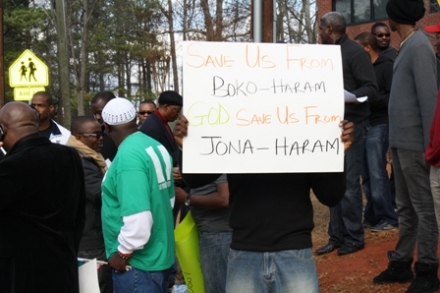


Nigerians, both at home and abroad seem to have found unison in decrying the lack of progress in the development of their country.
Continuous corruption, a lack of leadership, lack of security, the menace of Boko Haram terrorism, unemployment, a disengagement between the rulers and ruled. Nigerians all over the world including in the United States of America have had enough. They are expressing solidarity with their country folks, from New York to Texas to California to the state of Georgia. Here today is a tip of the iceberg, at the
recent “Occupy Nigeria-Atlanta."
Nigeria’s Arab Spring? - Fuel Subsidy Cuts Spur Protests - New America Media

Massive protests have rocked Nigeria since the subsidy cuts, with thousands of people demonstrating, an outpouring reminiscent of popular protests in Tunisia and Egypt. Thousands of miles away, fellow countrymen and allies in America are also supporting the protestors back home.
Shouts of “enough is enough” and “solidarity” by protesters punctuated the moments between speakers at the World Bank entrance in Washington D.C., where a contingent of security officers was hastily deployed to contain the small but very vocal crowd of approximately 75 participants.
Victoria Tairu, related on her motherʼs side to Babatunde Raji Fashole, the governor of Lagos State, was unabashed to be part of the demonstration. Born in America to Nigerian parents and now living in Prince Georgeʼs County, MD, neighboring the nationʼs capital, she said she was participating in the protest because “I really want to help directly my cousins and family back in Nigeria.”
Holding a sign, “No Fuel Price Hikes in Nigeria,” Tairu said she hoped her message would reach “the right seats and the right political positions” and lead to the reinstatement of the subsidy, as well as letting the Nigeria people know they are not alone. “Thatʼs my family; thatʼs my blood.”
Tairu said members of her Nigerian church in Prince Georgeʼs County “stay well connected” to friends and relatives in Nigeria through frequent visits to the country and Facebook. Through her informal monitoring of Facebook posts, she has concluded that any popularity the Nigerian president enjoyed has eroded.
Attendees and speakers at the Occupy Nigeria protest accused and Nigerian President Goodluck Jonathan of following World Bank and International Monetary Fund recommendations on allowing fuel subsidies to lapse.
The Nigerian ambassadorʼs office in the United States referred inquiries about subsidies to a news article on the embassy website. “The Minister of Petroleum Resources, Mrs. Diezani Alison-Madueke,” the article reads, “has enumerated the benefits of subsidy removal to Nigerians and the economy. The minister said the discontinuation of fuel subsidy is because it poses a huge financial burden on the government, disproportionately benefits the wealthy, encourages inefficiency, corruption and diversion of scarce public resources away from investment in critical infrastructure.”
The repeal of the fuel subsidies is expected to save the government an estimated $8 billion annually. Folabi Olagbaju, of Amnesty International, a speaker at the protest, said the subsidy cut was, “a very rude New Year present for Nigerians,” particularly, as he and others noted that the majority of the countryʼs over 155 million people live on less than two dollars a day.
He urged the Nigerian government to restrain from using violence on protestors. Already there have been reports in the Nigerian press of the deaths of and injuries to protesters as police seek aggressively to quell demonstrations numbering in the thousands in some cities, bringing normal day-to-day activities to a standstill.
The Washington protest was timed to coincide with the beginning of a general strike in Nigeria called for last week by the Nigeria Labour Congress (NLC) and the Trade Union Congress (TUC) -- if the Nigerian government left the subsidy cuts in place.
A NLC statement read at the rally said, “This action was [taken] without adequate consultation and without regard for the well being of the Nigerian people and will adversely affect the working class in our country. It is precisely because the policy prescriptions of the World Bank and IMF are swallowed whole by our government without regard for the socio-economic impacts on our people that we find ourselves in this situation today.”
A statement by a World Bank spokesman did not address policy recommendations. “We strongly support people's right to make their voices heard.
Ultimately, the Nigerian government and its citizens must determine how Nigeria's resources are spent to achieve significantly less poverty and more opportunity for all.”
Michael Leslie, of the AFL-CIOʼs American Center for International Labor Solidarity, who attended the Washington protest, explained that the removal of subsidies dips not only into the pockets of the poor for transportation, but across class lines and into the operating costs of entrepreneurs as well as small and large businesses which rely on gas-powered generators when, with regularity, blackouts occur. Leslie said data would likely show that Nigerians purchase more gas-powered generators than any other country in Africa.
Though Nigeriaʼs government says it plans to reinvest the savings from the fuel subsidy cuts into infrastructure improvements, Leslie said few Nigerians have confidence that revenue saved will be used for that purpose, because of rampant corruption.
“Nigerians have heard this before; nothing has happened. Theyʼre angry,” Leslie said. Omoyele Sowore, of SaharaReporters, an online news source of Nigerian-American perspectives, agreed, but cautioned against miscasting the protests as “merely a demand for a welfare state.” He noted, for example, that U.S. oil companies receive similar subsidies from Washington that help cushion fuel costs for consumers.
Alafaka Opuiyo, a Nigerian-American and a former journalist who donated her public relation skills to promote the rally, said she also plans to attend Fridayʼs march at the International Monetary Fund. Eyeing the crowd gathered at the World Bank, Opuiyo said, “I expect there will be a larger protest at the IMF. Weʼre just beginning.”
NLC Declares Weekend Break For Strikes, Rallies And Protests
|

Subscribe to:
Posts (Atom)